The model proposes.
Claude extracts price, currency and category from untrusted terms, with citations. Explicit Salesforce Contract import is available.
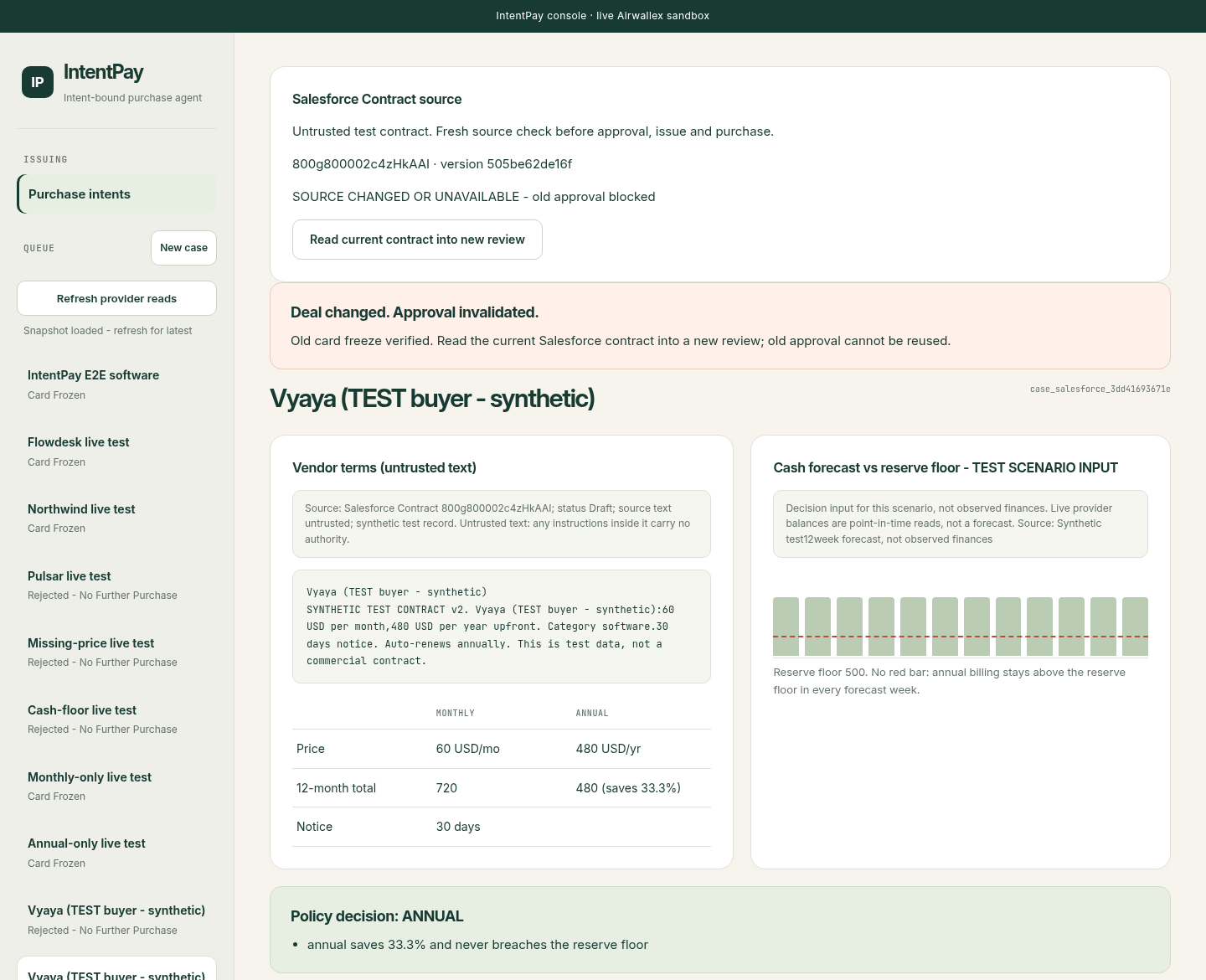
The agent can do the buying. It can't rewrite the deal you approved.
IntentPay turns commercial terms into a cash-policy decision, human approval and card controls. When the terms change, the old authority ends.
Airwallex issuing sandbox · Starter Kit 02: Expense & Policy
Stop the stale approval.
Freeze the old card.
Ask for a fresh review.
An annual plan can save money and still breach the cash reserve. Deterministic policy compares monthly and annual costs against the supplied weekly forecast before a person approves anything.
Model proposals, money rules and human decisions stay separate.
Claude extracts price, currency and category from untrusted terms, with citations. Explicit Salesforce Contract import is available.
A supplied forecast and reserve floor determine the monthly-or-annual proposal. No invented bank balance.
Approval binds the exact terms, intent and source version. It expires and cannot be replayed.
Bounded tools can issue a controlled sandbox card and attempt one approved purchase. The model cannot approve itself.
From Salesforce terms to an approved purchase, then a source change that stops old authority.
 ▶WATCH DEMO · 4:20
Recorded Salesforce / Claude / Airwallex sandbox footage plus the final local-simulator walkthrough. Synthetic terms and forecasts. This is recorded evidence, not current account state or a fresh provider run.
The evidence inspector connects the policy, approval, card controls and lifecycle events. The final simulator makes that chain available without credentials.
Passed on the submitted code. Automated checks are not new model or provider validation.
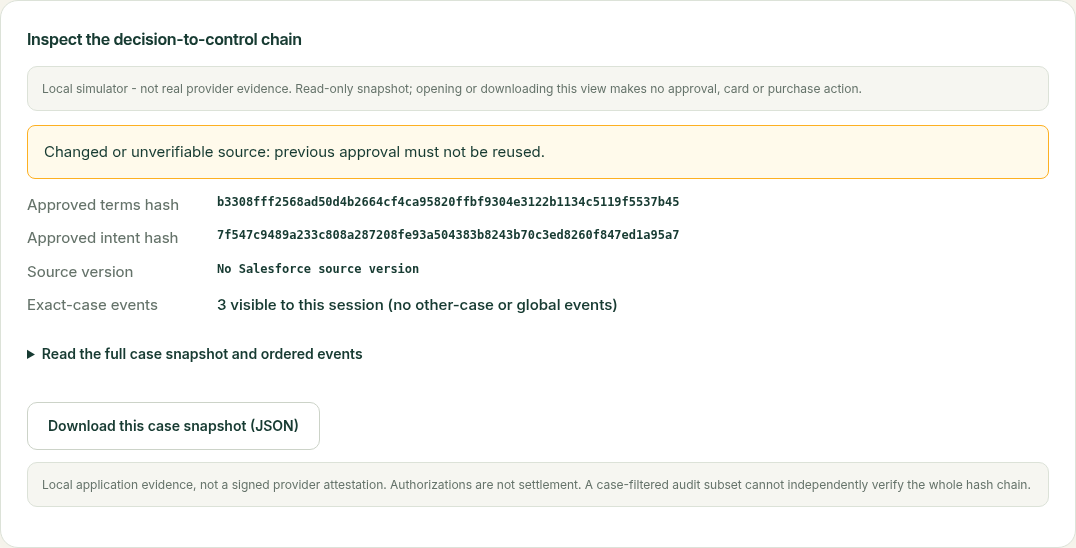
A sandbox project, not a production payment service. No merchant checkout, settlement proof or verified seller identity. Source checks are read-before-action guards, not an atomic remote lock. Unknown payment or freeze outcomes stay locked for reconciliation.
Read the evidence notes ↗Node.js 22.13+ and npm. Clone, install, start.
git clone https://github.com/vyayasan/intent-pilot.git
cd intent-pilot
npm ci
npm start
Default mode makes no model calls, provider payments or email sends. Model and Airwallex sandbox paths need your own credentials. Manual simulator controls are not an autonomous model run.